Wednesday, 4 May 2016

The Thought Goats


https://www.flickr.com/photos/roland/4723946116/in/photostream/
This gorgeous goat is courtesy of Roland Tanglao (Creative Commons)
Growing up, a favourite stop on family road trips was a little town named Coombs, located on Vancouver Island. Packed into our Lilliputian red Subaru four-door, and generally afflicted by a combination of road trip agonies (including the middle-seat engine hump, the gradual shellac of gum wrappers to knee and a variety of cries ranging from “You’re my faaaaavourite sister!” to “Coleslaw’s a fascist regime!”), all discord in the back seat was immediately forgotten as we pulled off the Highway 4A and a great cry arose:

            “Goats! I see the goats!” 
             “Goats on a roof, goats on a roof, goats on a roof!”
            “Goats!”

Yes, there are goats on the roof of the Old Country Market. When Kristian and Solveig Graaten built the market in the 1950s, they decided to include a sod roof—an energy efficient method of construction common (at the time) near Kristian’s original home of Lillehammer, Norway. Once the grass started getting too long, someone had the bright idea of “borrowing” some goats to keep it mowed—and they’ve been there every spring and summer since. They wander around on the roof, munching grass and generally being inordinately fascinating (I lost more than one ice cream cone in my life to being distracted by those goats).
These goats wandered back into my mind recently while studying Evagrius Ponticus’s topic of logismoi. Greek for the word “thoughts”, over the centuries the word has come to mean thoughts and mental distractions that come to lead us away from Christ—quite often at the point where one is trying the hardest to pray! In his Praktikos & Chapters on Prayer, Evagrius divides them into eight general categories of gluttony, impurity, avarice, sadness, anger, acedia, vainglory and pride, and says that every distracting and disquieting thought can find its roots in one of these categories. Left unchecked, these thoughts wander all over in our mind, chew up the energy we need for prayer and good works and generally distract us from our destination—that is, God.
Thus, I’ve unofficially dubbed the logismoi “the thought goats.” Don’t get me wrong, I love those goats on a roof. But what if, on those childhood goat-and-ice-cream stops, my entire family was so fascinated by those goats that we forgot our destination (Tofino, beaches, camping, the ultimate goodness of S’mores), the basic necessities required to get us there (gas, food, water, bathrooms, sunscreen, endless games of “I’m thinking of an animal”) and perhaps even tried to climb onto the roof to get a closer look at the goats’ wanderings? Consequences could have ranged from annoyance and delay to actual danger and the end of our trip together.
So, too, with the logismoi and trying to follow Paul’s exhortation to “pray without ceasing” (1 Thess 5:17).  The point of this is not to try to stop thinking entirely—that would be absurd. But, as Ecclesiastes says, “To every thing there is a season, and a time to every purpose under the heaven”—and the monastic schedule makes some of those times really clear! Figuring out ways to use spruce tips in cooking, or pondering a metaphor for a poem, or wondering if it would be better to plant carrots or bok choy in the garden are all valuable uses of the discursive reason—but if I’m munching on them in the middle of Adoration, it’s a pretty good sign that I’m following a thought goat.
So, what to do? In the Praktikos, Evagrius says that “it is not in our power to determine whether we are disturbed by these thoughts, but it is up to us to decide if they are to linger within us or not and whether or not they are to stir up our passions.” If each distracting thought, good or bad, is a goat, then if I pay attention, it’s like I’m offering the goat grass and inviting it to climb into the car with me and make a nice goat bed and maybe come camping with me too. I’ve never tried to roust a goat from a Subaru four-door, but I imagine that it’s pretty difficult!
I have tried (am trying) to roust out logismoi—and from what I can see from the lives of the Desert Ammas and Abbas, it’s a long fight in which victory consists not in banishing all the logismoi, but in not being disturbed and distracted when they do pop up. Various writers have called this state apatheia, purity of heart, recollection, interior silence or unceasing prayer, and descriptions of how to reach this state are pretty much unlimited.
But for me, I’ve discovered a simple and effective slogan to help me remember what I’m supposed to do: Don’t feed the thought goats!

Monday, 18 April 2016

Contemplative Practices


"The forest breathes.  Listen.  It answers,
I have made this place around you.
If you leave it, you may come back again, saying Here."


( An excerpt from the poem, Lost, by Pacific Northwest poet, David Wagoner )


-- Sister Elizabeth Marie 


Sunday, 3 April 2016

Christ is Risen! Truly, He is Risen!

Happy Easter from all of us here at Queen of Peace Monastery!

A little rain didn't dampen our Paschal fire (or our Paschal joy!), because Christ is Risen! Truly, He is Risen (or, as they say, Christus resurrexit! Ressurexit vere!) And now, the sun is out and we continue to exult and celebrate for the rest of Paschaltide.

Here are a few pictures from our celebrations, including the surprise we'd been cooking up since mid-February—Easter bread that was blessed and given away after the Easter Vigil!

So, we wish you and yours a happy and blessed Easter. You are all in our prayers.

The Light of Christ, Alleluia!
The Paschal fire.
The Gospel
The Easter aspergillum and aspersorium (implements used to sprinkle holy water).
Our Paschal candle, hand-poured by Sr Dominic Maria and Sr Florentina Marie, and then painted by Sr Isabelle.
Sister Elizabeth Marie with her first batch of bread!
Waiting for the blessing...
The sun shone for the entire Octave!
Tucker with his "Easter Egg."
Lotti with Tucker's Easter Egg (She did get one of her own, honest—she prefers his).

Wednesday, 23 March 2016

Into Loving Communion with All of Life

 For Christian churches using the Gregorian calendar to calculate their feast days, this past Sunday was Palm Sunday, which marks the beginning of what is called Passion Week or, in popular parlance, Holy Week.  Centered upon commemorating a culminating series of events in the life of Christ, this entire week leads up to the "feast of feasts" known as Easter Sunday or the Great and Holy Pascha, wherein the death and life-giving Resurrection of Jesus Christ is celebrated.  At this moment in the liturgical season, we are entering an extraordinary time that draws our awareness into the mystery of a life that is stronger than death, and so much bigger than ourselves.

If, as Dante once wrote, love moves the sun and other stars, then it surely has been moving them in an enchanting way, recently.  This past Sunday also happened to be, for those of us residing in lands throughout the Northern Hemisphere, the day in which the celestial phenomenon of the Vernal Equinox occurred.  You may recall that equinoxes are annual events, taking place in March and also in September, when the Sun's centre crosses Earth's equator in such a way that the hours of daylight and night are roughly of equal length.  Moreover, for many people, the Vernal Equinox symbolically inaugurates the beginning of springtime, the much anticipated season of nature in which the death-like dormancy of winter gives way to new life.

Lately, I've been thinking of how I am but one little human being on planet Earth, immersed in the margins of these cosmic death-and-life rhythms, as I begin working our cultivated lands around the monastery, doing what I can to assist our fruit trees in their growth and preparing the soil for the seed that will be sown later this spring.  I've already pruned the deadwood and water sprouts of the mature pear trees.  And, later this week, I hope to remove the mounds of decaying maple and alder leaves that are currently blanketing the garden beds, and begin lightly turning-up the soil to mix in the ash we've been collecting from our fireplace and wood stoves all winter long.  As every relatively proficient farmer or gardener knows, pruning encourages new and vigorous growth while amending the soil with organic materials such as wood ash, animal bones, manure, or composted food scraps, helps bring about nourishing and fertile soil conditions in which plants thrive.

In carrying out these and other horticultural tasks in the days ahead, I know I shall be happily steeped and stained in humus throughout this Holy Week, and beyond.  What is so joy-inducing about dirt, you ask?  I am in such bliss because it is precisely here and, in fact, everywhere, that you and I can enter more consciously, more intentionally, more deeply, into loving communion with all of life.  This is but one immensely profound facet of the meaning, and vast reality, of the Resurrection.  As the noted French theologian Olivier Clément beautifully elucidates: "Christ's Resurrection is not merely an increased assurance that our souls are immortal.  Its purpose is to rekindle life and love throughout the entire earth:  every living being and every object, every moment, every person, everything, in fact, from a blade of grass to the galaxies of outer space."


 -- Sister Elizabeth Marie


Wednesday, 16 March 2016

"They will be true monks, living by the work of their hands"

The title of this post might be a bit of a misnomer—as Dominicans, we follow the Rule of St. Augustine, not the Rule of St. Benedict. But there are some basic commonalities in the monastic family (and, frankly, the human family), regardless of rule, and one of those is the necessity of work.

As contemplatives, our primary work is, of course, offering a continuous sacrifice of praise to God through the liturgy. Still, just as Jesus did not spend his entire earthly life in the Temple or synagogue, but "devoted most of the years of his life on earth to manual work at the carpenter's bench" (Laborem Exercens Ch.6) , we also work with our hands to cook, clean and take care of the needs of the monastery and our beloved guests. Some sisters sew and mend our habits; others manage the finances or coordinate the liturgy; others take care of the archives, work in the print shop or manage the library. In the summer, we also plant, weed and harvest fruits and vegetables for the table. Each person is called upon to serve according to the talents and abilities God has bestowed upon her through both nature and training.

We are privileged enough, though, to have the time and resources to engage in work over and above the basic household chores and necessities of life. Thus, some sisters make handmade candles and natural soaps; others bake delectable treats to-order; others write sacred icons, or write books in various genres.

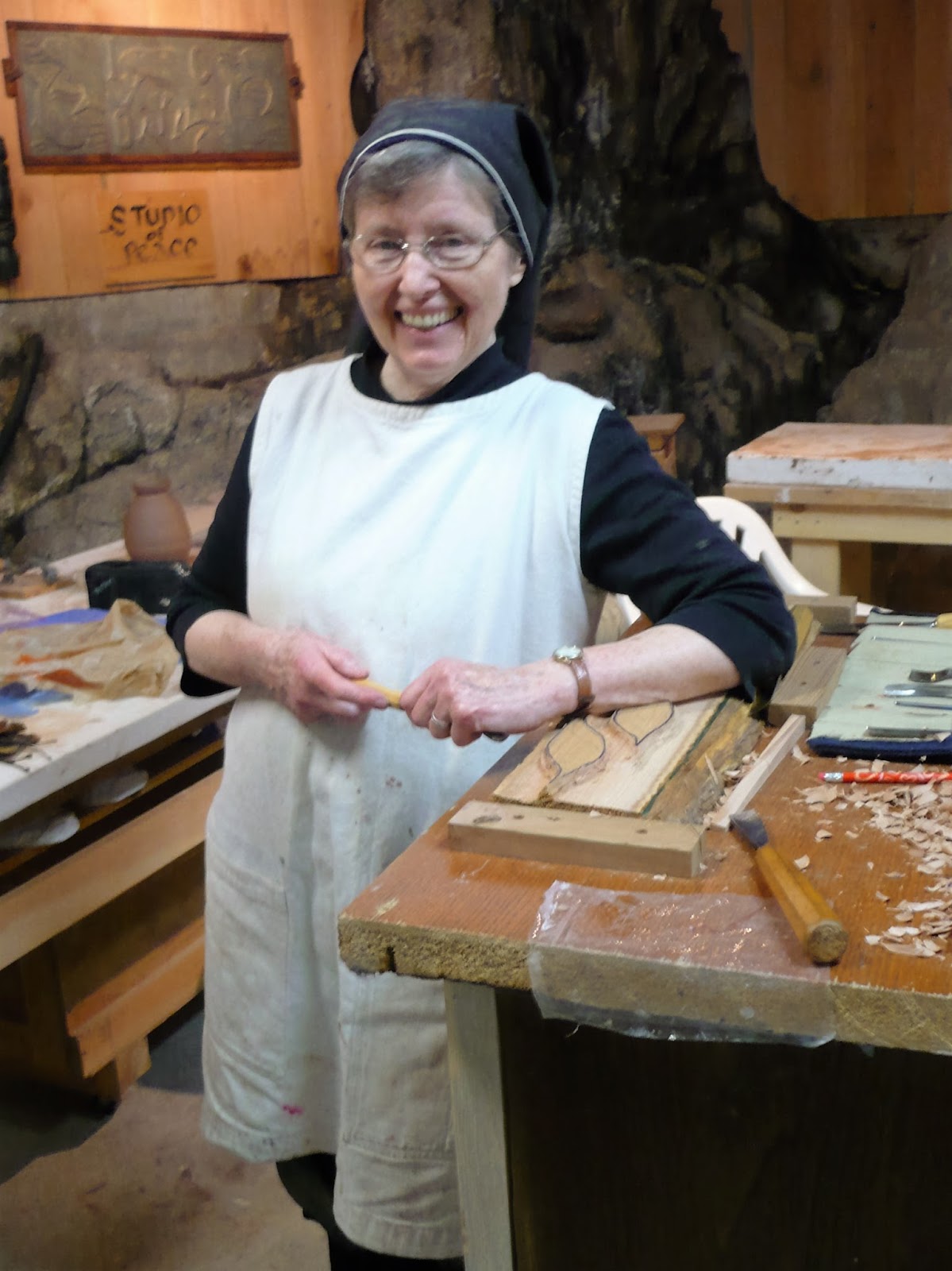
Since February, one of our resident craftswomen, Sr. Mary Magdalene, has been so good as to welcome the novitiate into the workshop to teach us two of her (many) specialties: pottery and wood carving. Sr. Elizabeth Marie is learning the way of the chisel and gouge; meanwhile, yours truly is attempting to become more centered (pun absolutely intended) on the pottery wheel.

Sr. Elizabeth Marie can speak to her carving experience at a later date, but for me, I know that it's interesting to learn the ways of working with a material that I have absolutely no familiarity with. Turns out that trying to knead (or "wedge") the clay like bread is the absolutely best way to work air bubbles into the lump, rather than out of it like you're supposed to. Not a few times I've scrambled hurriedly up the hill from workshop to Vespers, only to realize that I used too much water when spinning and am now covered in clay freckles.

And the experience of trying to wrestle four pound lumps of clay into (hopefully) vertical creations has also led me to interpret Isaiah 45:9 in a way that the original author probably did not intend:

            "Does the clay say to the potter, 'What are you making?' 
Does your work say, 'The potter has no hands'?"

In my case: yes, all the time!

So, here are some pictures from our work in the workshop—including a special appearance from a certain furry non-artisan.


Lotti being...well, Lotti.

Monday, 7 March 2016

Plant a Tree, Grow in Love


"An integral ecology is also made up of simple daily gestures which break with the logic of violence, exploitation and selfishness."
                                                                            ( Laudato Si', 230 )


                                                 -- Sister Elizabeth Marie


Wednesday, 2 March 2016

Novitiate Test Kitchen: Episode One

The novitiate's been quietly (or noisily, if the mixer is running!) at work in the kitchen and bakery over the past few days, contemplating God's gratuitous, generous Love and what that might mean in the context of a certain upcoming Feast of feasts—and in this case, the fruit of contemplation involves actual fruit!

Six adapted coffee tins and a whole lot of flour later, we've come up with a surprise, to be revealed (and tasted) in approximately four weeks. Until then...


...may your fast be joyful, and may your joy be in Christ!